Many animals quietly shared space in local fields and yards, leaving small traces that people often missed. Observers could learn a lot by checking the bark on a tree or scanning for tiny holes near roots.
NH 4-H Community Group members often posted photos of these finds, turning casual sightings into a shared learning tool. Those posts helped users match chewed leaves, nests, and scrape marks to specific creatures like squirrels.
Learning one clear sign improves how someone reads the living landscape. It lets them value the local biodiversity without seeing the creatures directly.
Preparing for Your Backyard Wildlife Observation
Small adjustments in timing and place reveal many different creatures and their routines. Observers should plan visits at varied times of the day—dawn and dusk often show different behaviors than midday.
To gather useful evidence, try a local trail or the yard near a water source. Wet or muddy areas produce clear tracks in spring, summer, and fall. The same area will tell different stories across the year.
Move slowly and look for disturbed leaves and broken stems. In winter, bare ground and sparse vegetation make it easier to spot food foraging and movement patterns.
Consistency matters: visit the same place often to document seasonal changes. Always get permission to explore private areas and keep safety in mind when studying local wildlife.
- Vary the day and season of visits.
- Check wet spots near water for tracks.
- Note subtle disturbances and food traces.
Essential Techniques for Spotting Backyard Animal Signs
Standing still for a few minutes can change what you notice about the local wildlife. A short pause lets sight and hearing reveal subtle activity that movement often hides.
Choosing the Right Time of Day
Early morning and late afternoon are prime time windows. Many different creatures move then and birds call more often.
Check damp patches and edges of water where soft soil keeps clear impressions. Those places commonly show animal tracks and disturbed leaves.
Utilizing Your Senses
“Listen and look,” advises Steven Sullivan of the Hefner Museum of Natural History. He says quiet observation brings the best clues.
Use hearing to detect squirrels and birds and sight to find marks on a trail or the ground. Move slowly so the area yields tiny clues.
- Pause and listen for movement and calls.
- Scan for different kinds of tracks and scratch marks.
- Return at varied times to learn how the area changes.
Interpreting Paw Prints and Track Patterns
A single paw print can reveal much about who passed through an area and how they moved.
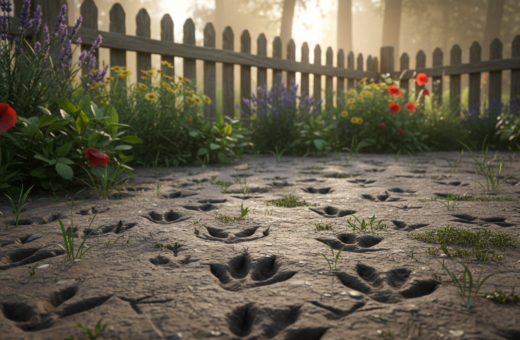
Examining prints in soft soil gives immediate clues. The shape of each pad and the alignment of toes help distinguish families. Canid tracks are roughly rectangular with the middle toes aligned. Felid prints tend to appear more circular, with one toe sometimes extending farther forward.
Distinguishing Between Canid and Felid Prints
Look for claw marks and toe placement. Canids usually show claws; felids often do not. Compare the feet impressions to estimate size and stride.
- Examine the pad shape to sort canid versus felid.
- In winter, slush may distort tracks as freezing and thawing expand prints.
- Disturbed leaves near a print show direction and speed.
- Raccoon and opossum prints can resemble tiny hands; note the opossum thumb angle.
Careful pattern analysis lets observers reconstruct movement across a yard with high accuracy. Multiple prints form a sequence that reveals pace, pause points, and likely intent.
Decoding Holes and Soil Disturbances
Not all ground disturbances are the same; shape and location offer quick clues. A brief look at the soil and nearby marks can show who has been active and when.
Identifying Mole and Gopher Mounds
Moles make volcano-shaped mounds by pushing soil up with their feet. Those lumps usually lack a visible opening and appear most often in spring and fall.
Gophers leave crescent-shaped mounds with a clear hole or tunnel opening. The shape and mound edge are the fastest way to tell them apart.
Recognizing Vole Runways
Voles make surface runways through grass and thatch. These paths look like shallow tracks and run beside trees, under shrubs, or near seed sources.
Voles are small but leave a lot of evidence; multiple narrow routes usually point to voles rather than moles or gophers.
Investigating Den Entrances
Den holes can belong to many creatures. To test an entrance, place a leaf or newspaper across the opening and check it the next day or night.
- Squirrels often dig small holes to bury seeds and nuts; those holes refill quickly.
- Skunks and raccoons dig for insects and grubs, leaving shallow pits that grass can recover from fast.
- Understanding excavation patterns helps identify voles, moles, or other local species in an area.
Analyzing Scat and Biological Remains
Traces like pellets, feathers, and insect frass tell a clear story about local diets and predators.
Examine pellets and droppings to learn what passed through an area. Ruffed grouse scat consists of cylindrical pellets about 3/4 to 1 1/4 inches long and often contains fibrous plant material. Those pellets are most common in winter.
Owl pellets frequently hold bones and fur from voles or rats. Finding a compact pellet with small skulls is a strong indicator of nocturnal predators nearby.
Raccoon scat often contains seeds and lacks the tapered ends seen in fox or coyote feces. Seasonal shifts appear too: spring and summer droppings include more fruit and insects than fall or winter samples.
Small remains by a trail—feathers or detached wings found in the morning—may mark a successful hunt by a bird of prey.
- Check pellets for plant fibers or bones to identify food types.
- Note the location relative to a tree, trail, or water source.
- Document changes by season to map predator-prey dynamics.
“Biological remains provide a practical, time-stamped record of who fed where and when.”
Identifying Bark Feeding and Tree Activity
A careful look at bark and stripped wood reveals who fed on a tree and when. Observers should scan trunks from the ground up to find chew patterns, cavities, and peck marks. Small features often mark seasonal activity and past use by insects or other wildlife.
Differences Between Mammal Chews and Woodpecker Damage
Mammal feeding leaves tooth gouges and ragged edges. Squirrels and rabbits remove thin strips of bark in winter to reach the cambium. Meadow voles work low on the trunk beneath snow, so look for close-to-ground feeding
Woodpecker holes are neat, round, and often show concentric drilling marks from a beak. The Norway spruce at James Kennedy State Forest revealed a perfect round cavity once used by honeybees, a reminder that bird activity and insect use can overlap.
- Beaver chews show organized rows of paired tooth marks near the ground.
- Deer leave hanging flaps of bark in spring because they lack upper incisors.
- Look for insect galleries inside cavities to explain past decay.
For guidance on protecting trees and reading bark damage, consult resources like healthy bark management. Recording the time, location, and type of mark will help separate winter feeding from summer nesting or insect activity.
Documenting Your Findings in a Nature Journal
A simple notebook can turn scattered observations into a clear record of local wildlife activity.
They should record the date, time, and exact place for every find. Note whether the discovery occurred in the morning, day, or at night. Short, dated entries build a useful timeline through spring, summer, fall, and winter.
When cataloging a deer bed, measure its shape and length. Deer beds are oblong or oval, about 25–45 inches long. That size helps indicate if resting happened by day or during night.
Sketch prints and marks on a tree or on the ground. Draw squirrel prints and note claw or tooth marks on bark. Add quick photos to confirm details later.
- Record weather and activity at the time of discovery.
- Label items like tracks, prints, leaves, or poop.
- Track repeated visits to the same area or trail to spot patterns.
“A well-kept journal becomes a map of who used the land and when.”
Conclusion
Drawing together tracks, scat, and feeding marks reveals patterns that single finds cannot. Observers who recorded details saw how small clues joined into clear stories about local animals.
Regular checks in the same field and notes taken over time built a fuller picture. Simple records showed when activity peaked, and which paths were used most often.
Begin each outing with a quiet scan in the early morning and finish by reviewing finds. Doing so helped them link one trace to many behaviors and to understand the ecosystem better.
Keep exploring and documenting. Every clear trace is a piece of a larger puzzle that helps protect and appreciate local life.