Novices often misread the small clues that show which animals visited a yard. A lack of basic knowledge makes it hard to tell one set of tracks from another. Simple signs like broken branches or mud footprints can be misleading without context.
Field research, including a 2018 study by Wildlife SOS in Chhattisgarh, shows that careful observation and patience matter. That project proved how a matriarch-led herd can leave subtle patterns over time.
To learn the correct direction and movement, beginners should check multiple sources. Local knowledge and science both help confirm which animal passed through. Seeing footprints alone can suggest a path, but patterns across an area tell the full story.
This guide will help readers build the skills to access and read the environment around gardens and fences. With the right approach, anyone can improve their ability to spot tracks, interpret signs, and follow trails safely and accurately.
Understanding the Fundamentals of Wildlife Tracking
Learning to read basic signs and animal behavior makes field observations far more reliable. Observers should focus on clear, repeatable clues: footprints, droppings, and disturbance patterns.
To master the fundamentals, he or she must learn common calls and typical movement. Remaining quiet and still helps animals act naturally and reveals honest behavior.
Digital tools speed identification. The Merlin Bird ID app is a practical companion for recognizing bird calls and narrowing the search for subjects in the field.
“Good tracking blends science with careful observation; it rewards patience and practice.”
- Study local habits to predict where an animal may move next.
- Professional trackers refine senses over years to spot subtle signs.
- Combine field notes with apps and local guides for better results.
Practice regularly and keep records. Small, repeated efforts build the skill set needed to read a yard or fence line with confidence.
Common Tracking Wildlife Mistakes Beginners Make
A clear-eyed approach prevents common errors when reading signs around fences and garden beds. Observers should slow down and treat each mark as a clue, not a conclusion.
The Danger of Preconceived Images
Beginners often force familiar shapes onto random marks. That habit turns stray scratches or tire ruts into false animal tracks.
Assume nothing. He or she must compare suspected prints to verified examples and check for context before deciding.
Overlooking Subtle Environmental Clues
Small signs like scat, tiny feeding traces, or crushed vegetation give vital hints about an animal’s food and movement. Missing these details leads to wrong direction and poor area interpretation.
Use multiple sources—field guides, local knowledge, and repeated observation—to build accurate patterns. Practice looking for several ways an animal could access a site.
- Study habitat and likely food to predict where animals appear.
- Record footprints and tracks over time to spot real patterns.
- Combine signs, scat, and movement direction before making an ID.
“Stay curious and let the landscape change your theory.”
Mastering the Art of Visual Scanning
Good visual scanning begins with a steady rhythm and a plan to sweep the scene in controlled layers. He or she should pan the eyes across the field of view in bands to avoid missing animals in thick brush.
Techniques for Scanning Fields of View
Work in layers. Start near, move to mid-range, then sweep the far edge. Scanning in a set direction reveals subtle movement patterns that casual observers miss.
- Slow and patient: Photographer Neal Parekh spent two weeks capturing the Belted Kingfisher in California and stresses a slow, detailed approach.
- Watch light and environment: Backlit subjects hide shapes; look for contrasting colors and open branches where an animal may rest.
- Read the area: Even without a visible animal, disturbed foliage and small signs narrow down direction and likely location.
- Keep a steady gaze: Professionals often scan about ten meters ahead to balance pace and observation.
“A steady, layered sweep turns the sweep of the eye into reliable detection.”
Interpreting Environmental Signs and Spoor
Small details in the soil and plants can reveal when and how an animal moved through an area. Careful observation of spoor, plant damage, and droppings builds a timeline of presence and movement.
Analyzing Footprint Condition
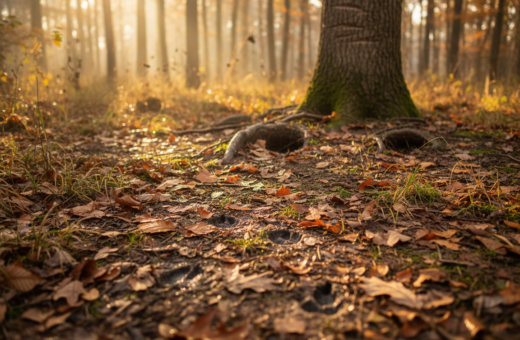
Footprints in soft ground or mud show age by edge sharpness and collapsing ridges. The Wildlife SOS team used mud prints to determine how recently an elephant herd passed through a site.
Researchers working with Canada lynx also measure impressions to infer weight distribution and distance moved on snow. Use the sun so ridges stand out when you inspect prints.
Identifying Feeding Patterns
Chewed branches, clipped stems, and specific leaf damage point to which species visited and what food they prefer. Mapping damaged plants along trails reveals likely feeding areas and future movement.
Recognizing Kill Sites
Kill sites are complex. Scat, scratch marks, and bone fragments all help reconstruct predator behavior. Distinguishing fresh from old scat gives a sense of time and the animal’s recent activity.
- Study paths and trails to predict direction through a field or habitat.
- Create hypotheses from multiple signs, then test with repeated observation.
- For deeper methods, see the spoor interpretation study.
“The science of following signs is a process of careful, repeated inference.”
The Importance of Patience and Stealth
Quiet patience often outperforms gear when trying to observe animals near fences and gardens. He or she should accept that a sighting can take hours or several visits. Time and steady practice build real skill.
Move slowly and keep low profiles. Avoid dry leaves and snapping twigs. Staying downwind reduces the chance an animal will detect a human by scent.
- Keep ears open for calls and subtle movement in the field or along a fence line.
- Minimize scent and avoid crossing known tracks; animals often circle back to their own trails.
- Use small, steady steps in long grass to lower visibility and distance cues.
Observe the whole environment. Watching for scat, fresh tracks, or shifted vegetation reveals direction and presence. Frustration is normal; knowledge and experience grow with patient, repeated effort.
“Patience converts brief signs into clear patterns.”
Utilizing Modern Tools and Local Knowledge
When scientific tools meet ancestral knowledge, observers gain safer access to rare species and clearer field data.
Local guides provide context that maps and apps cannot. The Irula tribe of Tamil Nadu, for example, offers expert help identifying the ‘Big Four’ venomous snakes. Their experience reduces risk and improves the quality of observations.
Modern tools add objective records. Wildlife SOS fitted radio transmitters to Indian Star tortoises to map feeding trails and daily activity. Radios and apps help log footprints, mud impressions, and scat for later analysis.
- Combine community knowledge with research to interpret tracks and signs across an area.
- Mark posts or trees where animals leave claw marks to follow likely paths and trails.
- Use apps and maps to document footprints, scat, and other evidence for future study.
“Respect local practice and record data carefully; the best results come from science paired with community wisdom.”
Ethical Considerations for Wildlife Observers
Ethical field work begins with choices that protect animals and their homes. An observer should always put the animal’s safety above curiosity or a photo opportunity.
Maintain a safe distance so the animal does not change course, hide, or act defensively. Use binoculars or a long lens to study behavior without approaching.
Avoid perfumes or strong soaps that mark you as an intruder. Human scent can alter animal routes and cause unnecessary stress.
- Do not rush or flush an animal to get a better shot or a closer look.
- Respect property and habitats; do not trample vegetation or open fences.
- If you find a kill site, observe quietly from afar and do not touch evidence.
Conservation groups like Wildlife SOS stress that the aim of field study is observation without harm. The goal is to learn and record, not to interfere with feeding, mating, or survival.
“Protecting habitat and reducing disturbance are the core duties of any responsible observer.”
Conclusion
Every visit to a garden or fence is a chance to refine how one reads subtle animal evidence. With steady patience and practice, an observer grows more accurate at spotting signs and following likely paths.
Avoid preconceived ideas and check multiple clues before deciding. Whether studying scat or a faint print, careful notes and repeat visits build a reliable record.
Modern tools can speed work: for example, research shows AI can dramatically reduce processing time—see how AI cuts wildlife tracking time. Use technology to support, not replace, field judgment.
They should continue observing with respect. The effort not only teaches about animals but also helps conserve local wildlife for the future.